
The 10 Best Things To Do in Corfu, Greece – Corfu Travel Guide
Corfu is considered one of the greenest islands to explore on your Greece holiday. Everywhere you go, you will see olive trees, acacia trees and citrus fruits. The baby orange tree (kumquat) is particularly characteristic of Corfu. If you like marmalade, you should definitely try kumquat marmalade here. What makes your holiday on Corfu even more special are the many beautiful Things to do, sights and attractions that the island has to offer. We’ll tell you which must-sees should absolutely be on your sightseeing list.
If you only know the islands of the Aegean Sea, Corfu will reveal a completely different side of Greece. Colourful, magnificent villas replace white cube houses, and the barren landscape gives way to lush green coniferous forests.
Corfu is also a paradise for nature lovers, who can enjoy the lush flora of the green island in the Ionian Sea in all its glory, especially in spring, during long hikes or bike rides.
By Dirk Pohlers, balkan traveller from Germany. I visit every place I write about & share real tips, photos, & advice from my trips.
In addition, Corfu revealed itself to us as a Greek bathing paradise with an almost endless variety of beaches. Secluded bays with white pebbles and rugged cliffs in the north alternate with golden sandy beaches and dune landscapes in the south. Everywhere, the sea shimmers in the most beautiful shades of blue.
Table of Contents
Corfu Town – The island’s capital
No holiday in Corfu would be complete without a trip to the capital of the same name.
A must-see on any Corfu holiday: the capital of the same name. Corfu Town, also known as Kérkyra, is the tourist centre of the island and has even been designated a World Heritage Site by UNESCO. The historic town centre, is particularly worth seeing, not least because of the unique blend of Venetian, British and French architecture. The narrow streets wind their way through rows of Venetian houses in pretty pastel shades, featuring balconies, colourful flowers and traditional wooden doors. A highlight of the old town is the Liston Arcades, a chic shopping street with numerous cafés and bistros. Also very beautiful are Platia Dimarchiou with the town hall and Platia Kremasti.
Corfu Town is dominated by two castles: the Old Fortress from the 16th century and the New Fortress are only about a kilometre apart and tower over the town’s harbour. Corfu also offers a number of cultural attractions: in addition to the Archaeological Museum, the town is also home to the Byzantine Museum and the only Museum of Asian Art in Greece. The latter is housed in the enchanting Palace of St. Michael and St. George, a magnificent Regency-style building designed by architect George Whitmore.
Foodies should definitely plan a stop at the weekly market in Corfu Town, where freshly caught fish and numerous regional products are sold over the counters. Those who prefer a quieter atmosphere should take a detour to the Kampielo district, the oldest quarter of the city. It is usually less crowded than other areas of the city, and the atmosphere is relaxed.
Tip: From Corfu Town, it is not far to the Vlacherna Monastery on the Kanoni Peninsula, which is also well worth seeing. From there, boats depart for the tiny but picturesque Mouse Island, which lies off Kanoni.
We recommend renting a car upon arrival so that you can be flexible and travel around the whole island. Due to the size of the island, you can easily book your hotel in one place and still go on daily excursions across the island. Don’t miss out on this opportunity, as it’s the only way to discover the full beauty of Corfu!
Highlight on Corfu – The Achilleion Palace
The Achilleion Palace was built on behalf of the Austrian Empress Elisabeth (Sisi).
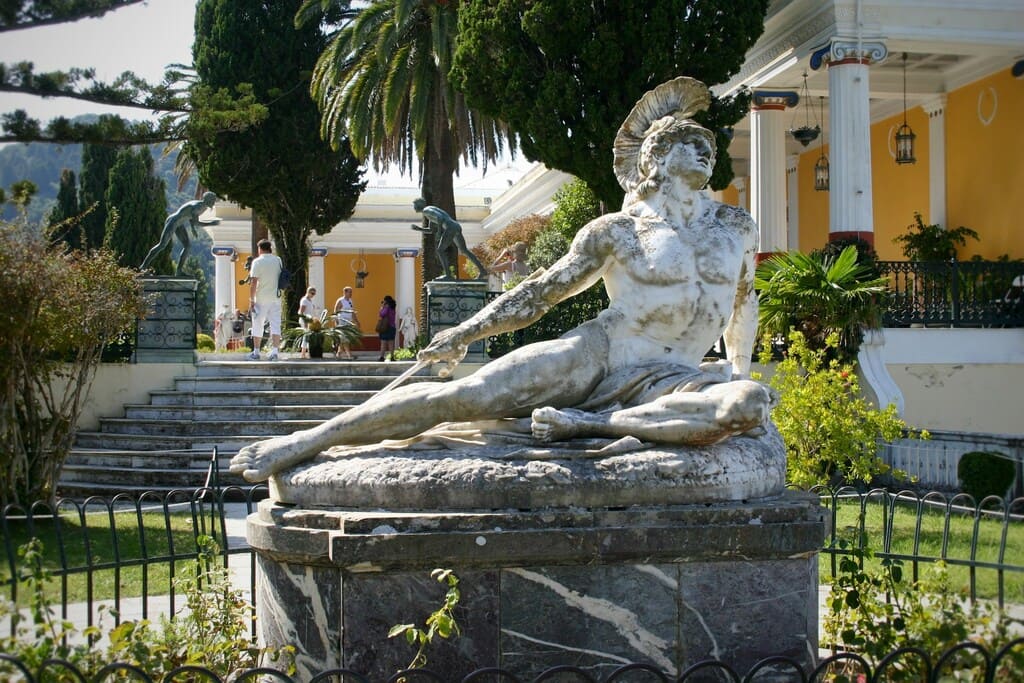
This gem was built at the end of the 19th century on behalf of the Austrian Empress Elisabeth (Sisi), who wanted a retreat on Corfu. Architect Raffaele Caritto is responsible for the neoclassical, cream-white palace with columns in the east of the island. The magnificent building was named after the Greek hero Achilles, whose image was immortalised in several statues in the adjoining garden and whom Sisi is said to have revered. In 1907, German Emperor Wilhelm II purchased the Achilleion Palace and made it his summer residence.
Visitors can still view the interiors, decorated with frescoes, stucco and marble, where original furnishings and personal items belonging to the imperial former owners can also be admired. It is also recommended to stroll through the palace gardens, which offer an excellent view of the sea.
Angelokastro – The old fortress
A symbol of resistance: Angelokastro Castle, perched on a rocky outcrop above the sea.
Just ten kilometres further north is the next building worth seeing on Corfu: the castle called Angelokastro. The ‘Castle of the Angel’, as the fortress is called in English, owes its name on the one hand to the Archangel Michael – there is also a chapel inside the castle dedicated to him – and on the other hand to the Venetians, who built it during their rule over Corfu and gave it its Italian title.
The Venetians used this fortress to protect Corfu from enemy attacks. For many islanders, Angelokastro is still considered a symbol of resistance today, as this fortress was never conquered and withstood all attempts at destruction.
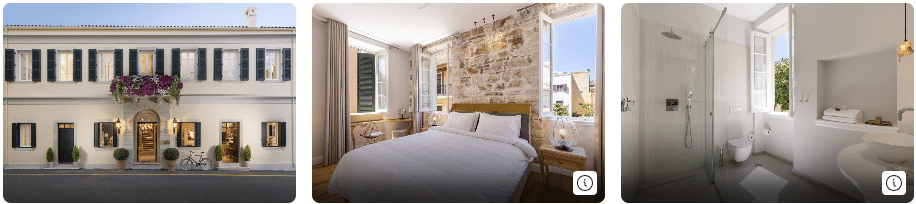
Hotel Tip: Acanthus Blue Hotel – In a quiet location on the southern outskirts of Corfu Town, the Acanthus Blue Hotel is an excellently rated, charming 3-star hotel with an authentic atmosphere. Just a few metres from Garitsa Boulevard by the sea, and only 700m from Mon Repos beach, it offers an excellent breakfast and friendly staff. ☑ Check prices and availability now.
The Angelokastro Fortress is located on a 305-metre-high rock directly above the Ionian Sea. The best way to get there is on foot. There are many hiking trails winding through olive groves and forests. Thanks to its exposed location in the west of Corfu, this building also offers fabulous panoramic views of the sea and the setting sun. In addition to the chapel of Archangel Michael, the ruins of the garrison with well-preserved living quarters are also worth seeing inside.
Paleokastritsa Monastery in the west of Corfu
A mixture of whitewashed and yellow buildings, stone archways and countless pink and purple bougainvilleas climbing up the walls: This is the Paleokastritsa Monastery in the west of Corfu. It dates back to the 13th century and is still home to a handful of monks today. Visitors can see the yellow bell tower towering over the monastery’s courtyard from afar – it is the abbey’s landmark.
But Paleokastritsa Monastery is not only pretty to look at, there is also a lot to discover here: the monastery museum, for example, exhibits liturgical vestments and old manuscripts. The monastery shop houses a historic olive oil press, which is still used today to demonstrate how the oil is produced. And if you like, you can even examine a gigantic whale skeleton on site, the origin of which is still unclear today.
From here, you also have a fantastic view of Paleokastritsa Bay, which attracts visitors with its turquoise sea, golden sand and lush green vegetation. The monastery is located on a rocky outcrop above the sea. As it faces west, this is one of the best places to watch the sunset on Corfu.
The Ghost village on Corfu – Perithia
A ghost village straight out of a storybook: Perithia on Corfu.
This mountain village in the interior of the island seems to have fallen out of time. Perithia is the oldest still existing village on Corfu, with a population in the single digits. For this reason, the hamlet is often referred to as a ghost village. When the threat of pirate attacks diminished in the 20th century, many of the former 1,200 inhabitants moved to the coastal towns of Corfu.
There are still around 130 Venetian houses in the village, some of which are still maintained, as well as eight different churches and a few taverns for visitors. There you can try sykomada, a typical Greek fig bread, for example.
Strolling through the cobbled alleys of Perithia, you will discover not only restored houses but also dilapidated stone buildings. This is what gives the ghost village its charm today. The village’s eight churches exude a special resilience and defy decay. Perithia is located at an altitude of 420 metres. The surrounding countryside is characterised by numerous herbs and wildflowers, lush green valleys and gentle slopes. From here, it is easy to hike up to Pantokrator.
Kassiopi – The Picturesque harbour town on Corfu
The harbour town of Kassiopi is ideal for strolling and taking a deep breath.
The harbour town of Kassiopi is located in the north-west of Corfu and offers impressive views of the Albanian coast from numerous points. For example, from the castle of Kassiopi: the Byzantine fortress – or rather what remains of it today – is located on a hill and towers above the village. Also well worth seeing is the port of Kassiopi, where boats and yachts regularly moor and which is lined with various hotels and tavernas.
Despite its modest size – only about 1,200 people live here – there are numerous hotels and restaurants throughout Kassiopi, and the infrastructure is geared towards tourists. Be sure to try the dish pastitsada in one of the authentic Greek taverns: braised meat in a spicy tomato sauce with pasta. Or moussaka, a casserole with minced meat and aubergines.
The Church of the Panagia Kassopitra is also well worth seeing in Kassiopi. If you want to go swimming, Bataria Beach is the place to go: the pebble beach is located on the edge of the village, and the sea here is ideal for swimming.
Hiking Pantokrator – The highest mountain in Corfu
Magnificent: the view from the summit of Pantokrator over Corfu and the sea.
Around 25 kilometres south of Kassiopi rises the highest mountain on the island: Pantokrator. If you enjoy hiking, you shouldn’t miss this sight on Corfu. Several hiking trails lead up to the 906-metre-high summit, which offers an impressive panorama of Corfu and the Ionian Sea. One of the most popular routes to the top is certainly the hiking trail from the old mountain village of Perithia. But don’t worry: you can also get there by car, and there are several car parks at the summit.
Once you reach the top, be sure to visit the Moní Ypsiloú Pantokrátoros monastery. The building dates back to the 14th century, but has been renovated several times over the centuries. Monks still live in the monastery today. For locals, the building complex is an important place of pilgrimage: every year on 6 August, the feast day of the Pantokrator, many islanders come here.
The Moní Ypsiloú Pantokrátoros monastery is nestled among olive groves and cypress trees. From the summit, visitors have a 360-degree panoramic view of Corfu, the Ionian Sea and as far as the Albanian coast. Depending on weather conditions, you can even see as far as Italy on the other side.
The most beautiful sights on Corfu: Lake Korission
Lake Korission in the south-west of Corfu is still an insider tip – at least that’s what you might think, given how quiet and secluded it is. Many tourists don’t stray here, yet the freshwater lagoon is the perfect place to slow down. With a length of five kilometres and a width of two kilometres, this body of water is the largest lake on the island. It is located in a 6,000-hectare nature reserve that boasts impressive flora and fauna and is home to more than 120 species of birds. In addition, numerous otters, turtles and fish species live here.
Only a narrow strip of coastline separates Lake Korission from the Ionian Sea, which is why it is often referred to as a lagoon. Hiking and cycling trails wind their way around the lake. Visitors should be sure to pack mosquito repellent for the evening. Tip: if you want to combine a visit to Lake Korission with sunbathing, you can visit Chalikounas Beach or Issos Beach, both of which are nearby.
Corfu – Things To Do and See in the West
Between Glyfada and Paramonas in the west of the island of Corfu, the narrow coastal road winds its way through traditional villages, down to wide sandy beaches and past pretty monasteries. For motorists, the steep gradients and tight bends pose constant challenges, so after an adventurous journey, you are usually glad to have reached your destination.
Mass tourism has left its mark on Glyfada, and beaches and popular sights are usually very busy in July and August. If you want to explore the region in peace, it is best to visit in the off-season if possible. Unfortunately, the parking situation at most beaches is chaotic and the access roads are sometimes adventurous. It’s best to allow extra time and, if necessary, walk a few metres to the beach.
Myrtiotissa Monastery
Coming from Paleokastritsa, our first stop takes us to the beautiful Corfu monastery of Myrtiotissa. The 16th-century church is located directly above the coast, and the only monk still living here enjoys a magnificent view every day.
- Myrtiotissa Monastery opening hours: daily 8 a.m. to 1 p.m. and 5 p.m. to 8 p.m., admission free – donations welcome
Kaiser’s Throne – Corfu’s Iconic Viewpoint
The Kaiser’s Throne near Pelekas is a magnificent vantage point both during the day and in the evening. Even the German Emperor Wilhelm II loved this hill on Corfu, from which you can enjoy a fantastic panoramic view of the entire island.
Agios Gordios Beach
At Agios Gordios Beach, behind the Bar Black Rocks, there is an old shipwreck and a long stretch of wild beach where you can swim in relative peace. The strong swell in the winter of 2020/21 has taken its toll on the Corfu shipwreck, leaving only fragments of it remaining. As a result, the sight is far less spectacular than the Zakynthos Shipwreck.
Nevertheless, it is worth taking a walk along the wild coast. Above the hamlet of Aspes, there is a great viewpoint (Aerostato). Not far from Agios Gordios, you can take a detour to the unspoilt villages of Kouramades and Sinarades. Here you can get an insight into traditional Corfiot village life.
Corfu insider tip: Agios Nikolaos Beach
One of our favourite swimming spots on Corfu was the small beach at the Agios Nikolaos chapel just behind the village of Paramonas. An unpaved road leads to a vineyard and then turns into a footpath that leads down to the coast.
Once you reach the bottom, you will find a fine sandy beach and crystal-clear, warm water next to the bright white chapel. The former harbour bay has now silted up and you can walk metres into the sea. The clean beach is natural and offers little shade, so you should bring a parasol, snacks and drinks for a day at the beach.
Do you need a rental car on Corfu?
Without question, a car is the most convenient and easiest way to get around Corfu. Although there is public transport, buses mainly run between the well-known places. If you want to explore small bays or unknown places, it is better to book a rental car.
We compared various providers via DiscoverCars and opted for Budget. We paid around 400 euros for 10 days – including the most important insurances. This is also important in Greece, as the roads can be a bit chaotic.
Explore Cape Drastis
Cape Drastis, one of the island’s most impressive natural sites, is located in the far north-west of Corfu. Rugged white limestone cliffs rise up out of the turquoise sea, bizarrely shaped by wind and water. In between are small bays and hidden beaches, often only accessible by boat.
- Location: Cape Drastis (Ακρωτήρι Δράστης)
The view from the viewpoint above is breathtaking – especially in the evening hours when the light of the setting sun makes the rocks glow golden.
Take a Boat trip from Corfu to Paxi
If you’re still looking for ideas for a day trip, we highly recommend visiting Paxi and Antipaxi. Paxi is a small island south of Corfu. Here you will find a little paradise within paradise: clear water, clean beaches and hardly any tourists.
- Location: Gaios is the main port on Paxos, the smallest of the seven principal Ionian Islands, in Greece
The best way to get there is to take a ferry from Corfu to the small town of Gaios. From there, you can rent a bike and explore the island and its most beautiful bays. However, the best way to get to know the island is undoubtedly by motorboat, as some places are only accessible by water. You don’t need a licence to drive one, so let’s go!
What is the most beautiful place on Corfu?
The most beautiful places on Corfu are the old town of Corfu Town (Kerkyra) with its Venetian architecture, picturesque Paleokastritsa with its bay and monastery, the romantic sandy beach of Glyfada, and the wild and romantic Canal d’Amour near Sidari. The mountain village of Afionas with its panoramic views and the highest mountain, Pantokrator, are also particularly charming places on the island.
What are some insider tips for Corfu?
Insider tips for Corfu include the hidden Agios Nikolaos Beach with its idyllic chapel, the authentic fishing village of Boukari for traditional tavernas, the hike to the summit of Mount Pantokrator for breathtaking views, and the abandoned ghost village of Palea Peritheia for a journey into the past. You can also visit the quiet Notos Beach or take a day trip to the islands of Paxos and Antipaxos.

Hi. I’m Dirk, adventure traveller, originally from Germany. In 2020, Island Hopper Crete, started as a Greece travel blog. In 2022, I founded a small travel agency in the Balkans to complement my recommendations with some of the best experiences that I found, organized by local partners and friends.
 English
  Français
  Nederlands
  Español
  Polski
  Svenska
  עִבְרִית